
Warren Buffett is one of the most iconic and successful investors of all time, earning him the nickname, “The Oracle of Omaha.”
It’s difficult to overstate the level of insight and experience this one man holds. At 94 years old, he has been leading Berkshire Hathaway since 1965 and investing for more than 80 years – having bought his first stock at just 11 years old, back in 1941. It’s hard to imagine anyone alive today with a longer history of investing.
For some perspective, here’s a brief history of the major events he’s lived, and invested, through:
- Great Depression: 1929–1939 (when he was born)
- World War II: 1941–1945 (when he first invested)
- Korean War: 1950–1953
- Cuban Missile Crisis: 1962
- Vietnam War Escalation: 1965–1975 (when he took over Berkshire Hathaway and became a millionaire at age 37)
- Nixon Shock and End of Bretton Woods: 1971
- Oil Crisis: 1973–1974 (-47% market crash)
- Black Monday: 1987 (when he started investing in Coca-Cola)
- Savings and Loan Crisis: 1986–1995 (when he became a billionaire)
- Gulf War: 1990–1991
- Dot-Com Bubble: 1999–2000
- Dot-Com Crash: 2000–2002 (-49% market crash)
- 9/11: 2001
- Global Financial Crisis: 2007–2009 (-57% market crash)
- European Debt Crisis: 2010–2012
- Brexit Referendum: 2016 (when he started investing in Apple)
- COVID-19 Pandemic: 2020-2023 (when his net worth hit $100 billion)
- Russia-Ukraine War: 2022–Present
- U.S. Inflation Surge and Rate Hikes: 2022–2023 (when his close friend and business partner, Charlie Munger, died – after having worked together at Berkshire for 45 years and having known each other for over 60 years).
- Trump’s tariffs: 2025
It’s almost impossible to fathom the economic, social, and technological changes he’s seen first-hand.
And even now, in his nineties, he remains sharp and reflective – still writing an annual shareholder letter packed with insight. He’s been writing these since 1965, and has recently announced he’ll retire at the end of 2025; therefore, his 2025 shareholder letter may be his final one.
So, with that in mind, it’s worth taking a closer look at what could be the closing message from one of the greatest investors who’s ever lived.
The 2025 Shareholder Letter
These three paragraphs stood out the most in Buffett’s 2025 letter:
“Berkshire shareholders can rest assured that we will forever deploy a substantial majority of their money in equities – mostly American equities although many of these will have international operations of significance. Berkshire will never prefer ownership of cash-equivalent assets over the ownership of good businesses, whether controlled or only partially owned.”
“Paper money can see its value evaporate if fiscal folly prevails. In some countries, this reckless practice has become habitual, and, in our country’s short history, the U.S. has come close to the edge. Fixed-coupon bonds provide no protection against runaway currency.”
“Businesses, as well as individuals with desired talents, however, will usually find a way to cope with monetary instability as long as their goods or services are desired by the country’s citizenry. So, too, with personal skills. Lacking such assets as athletic excellence, a wonderful voice, medical or legal skills or, for that matter, any special talents, I’ve had to rely on equities throughout my life. In effect, I have depended on the success of American businesses and I will continue to do so.”
Let’s break this down and explore it in more detail.
Good Businesses
“Berkshire will never prefer ownership of cash-equivalent assets over the ownership of good businesses.”
This line is a perfect summary of Buffett’s long-standing investment philosophy. He’s spent decades building wealth by investing in – and sometimes outright owning – high-quality companies.
Investing, at its core, is simply buying into businesses. When we invest in shares, we’re becoming part-owners of real-world companies that provide goods and services we all use daily. Buffett has grown his fortune, and helped many others grow theirs, by backing such companies through Berkshire Hathaway.
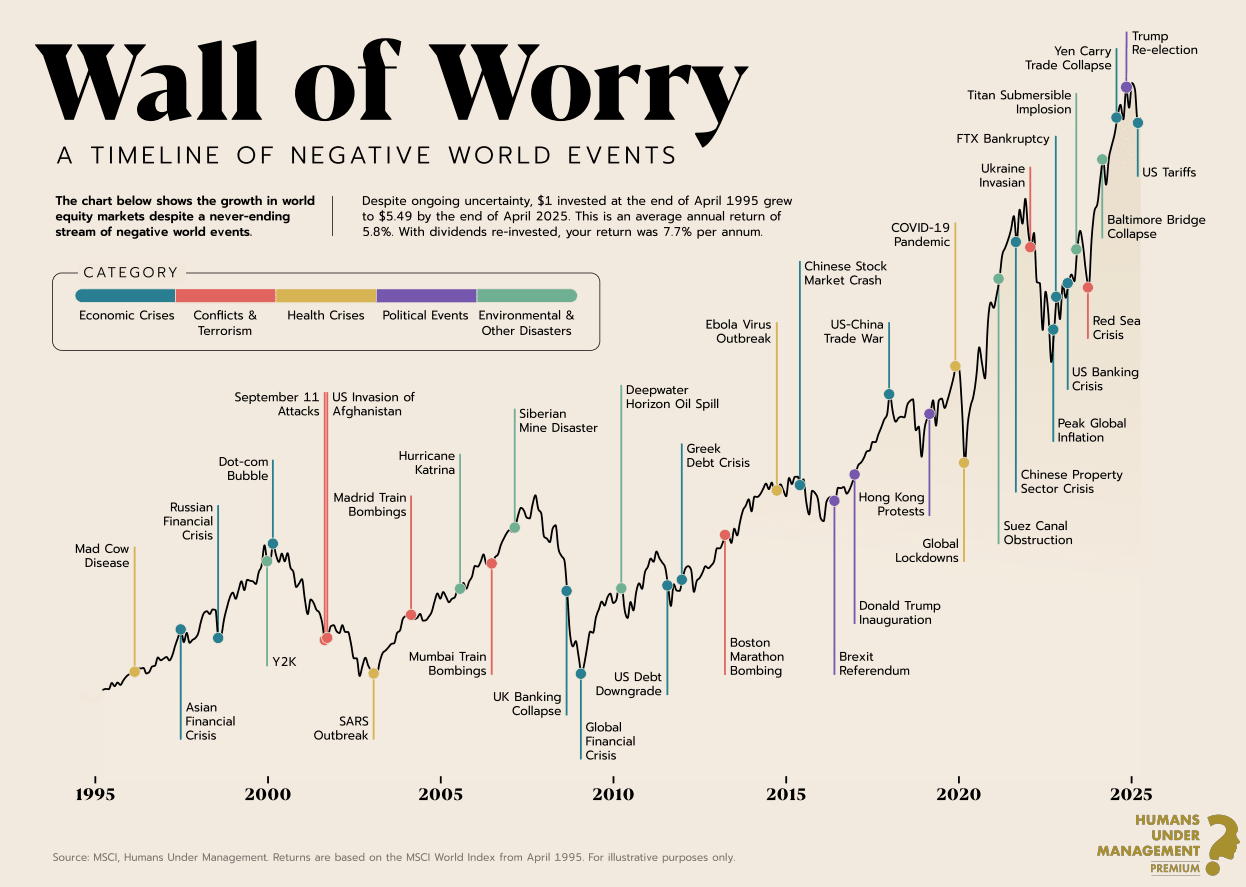
What sets these businesses apart is their ability to adapt, innovate and continue generating profits, even during turbulent periods of economic crises, conflicts and disasters:
Source: Humans Under Management (HUM)
“Businesses… will usually find a way to cope with monetary instability as long as their goods or services are desired.”
Well-run companies continue to trade and grow through tough times, rewarding patient investors along the way. Even if we’re not hand-picking the next Apple or Amazon, broad exposure to the global stock market means owning a share of this innovation and resilience.
This is a reminder that your portfolio isn’t just made up of numbers on a page – it’s made up of real companies doing real work. When we model a client’s future lifestyle with cashflow planning, it’s this ownership of productive businesses that helps keep their goals on track.
While Buffett and his team spend immense time choosing which specific companies to own, his advice to the average investor is simpler: buy the whole market, keep costs low, and stay the course.
Why?
Because over time, businesses create wealth.
“I’ve had to rely on equities throughout my life… I have depended on the success of American businesses.”
Unlike cash or bonds, which represent a loan to someone else, equities represent ownership of something productive – real people building real value, on your behalf.
Cash Diminishes, Businesses Deliver
“Paper money can see its value evaporate if fiscal folly prevails.”
This is Buffett’s warning about inflation – the slow (and sometimes not-so-slow) destruction of your cash’s purchasing power.
Like a tree rotting from the inside, inflation hollows out your money.
It’s a painful truth that many are only now recognising after the inflation surge of 2022–23. Even seemingly “safe” investments like bonds or savings accounts offer little protection over the long term if they fail to keep pace with ever-rising prices.
“The worst investment you can have is cash… Cash is going to become worth less over time.”
(2012 Letter)
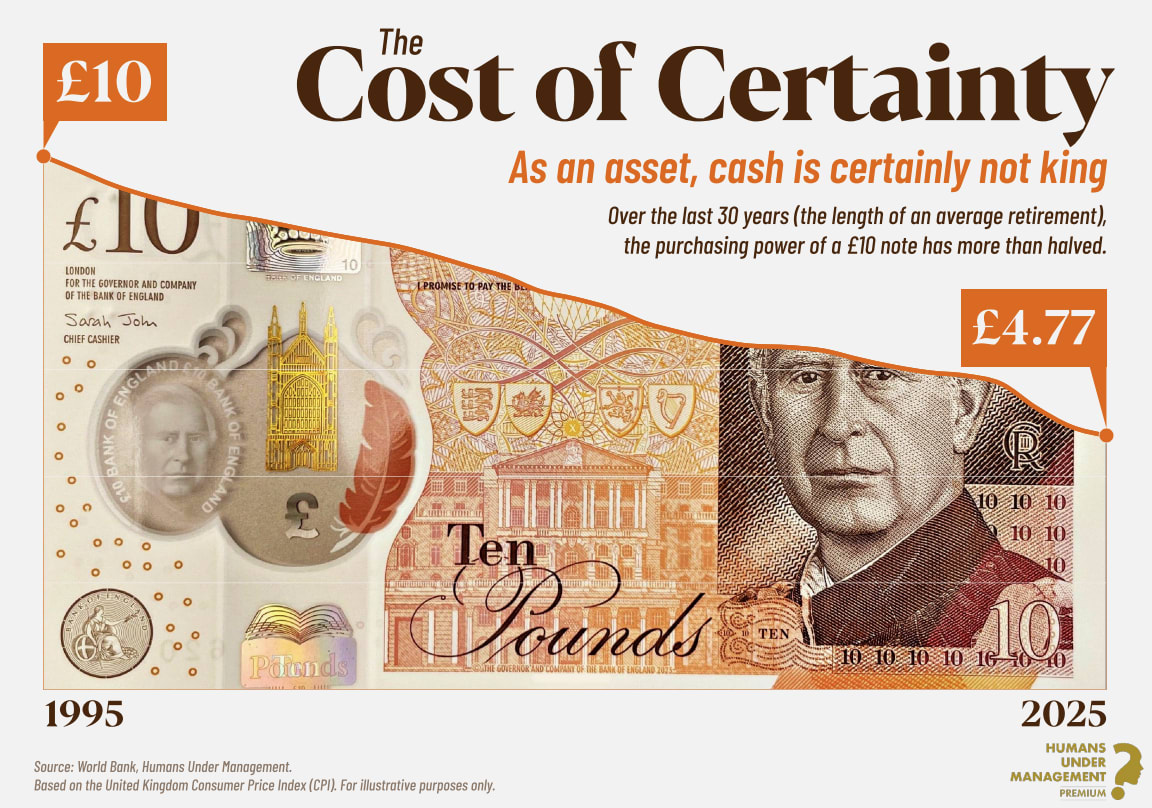
Lets look at the impact of inflation on cash over time:
Source: Humans Under Management (HUM)
Over the last 30 years cash has underperformed inflation by over 50% – which means the cash has lost over 50% of its purchasing power (i.e. it’ll only be able to buy 47% of the goods and services it could’ve bought in 1995).
This is an important reminder that safety is not the same as stability. Just because your savings account balance doesn’t fluctuate, it doesn’t mean your wealth (as measured by purchasing power) is protected.
For many clients, this is why we invest – not only to grow wealth, but to preserve its purchasing power. Holding too much in cash, beyond short-term needs and emergency funds, can jeopardise long-term goals like retiring early, gifting to children, or affording life’s experiences.
By contrast, businesses raise prices, grow earnings, and – in the right hands – pass on value to shareholders. Owning a portion of these businesses is how you beat inflation.
If you want to at least maintain – or improve – your quality of life over time, you need to grow your money faster than inflation eats it away.
And how do you do that?
By owning productive assets (e.g. businesses) and letting them work on your behalf.
Own The Future
Buffett has said many things over the years, but one of his most memorable lines remains:
“When we own portions of outstanding businesses… our favourite holding period is forever.” (1988 Letter)
In other words: pick a sensible, diversified investment strategy and stick with it.
Don’t jump in and out. Don’t chase headlines. Let time, not tactics, do the heavy lifting.
We reflect this in our own investment philosophy and planning process – encouraging clients to adopt a disciplined, low-cost, evidence-based strategy that grows quietly in the background while they get on with living their lives.
A Final Word: Bringing It Back to Financial Planning
“Someone is sitting in the shade today because someone planted a tree a long time ago.” (1991 Letter)

Warren Buffett’s 2025 letter is a timely reminder of the principles that underpin long-term financial planning.
His lifelong faith in productive businesses over cash-equivalent assets directly echoes the core of how we build plans for our clients at rockwealth Cambridge: by investing for the future, managing risk sensibly, and staying the course through the ups and downs of global markets.
Buffett acknowledges that not everyone is born with a “special talent” – and that’s exactly why investing in equities has been his lifelong strategy. The same applies to many of us: whether your goals involve supporting your children, maintaining your lifestyle in retirement, or protecting against future uncertainty, investing in the great businesses of the world gives your money the best chance of growing over time.
As financial advisers and planners, we’re here to apply these timeless principles to your personal circumstances:
- Your financial plan helps identify how much can be safely invested without disrupting your lifestyle.
- Your portfolio is built to balance risk and return, protecting against inflation and giving you the best shot at achieving your goals.
- Your emergency fund gives you the resilience to handle life’s uncertainties.
Buffett’s words remind us that success in investing comes from owning productive assets, being patient, and having a clear plan and that’s exactly what we build with you – a strategy not just to preserve your wealth, but to use it with purpose.
Thanks for reading.
Retirement and Financial Advisers in Cambridge
Interested to work with us?: Begin your retirement journey with us through an Initial Discovery Consultation, completely free of charge and without any obligation. You can visit us at our office, schedule a video call, or call us on: 01223 983 616.Discover us at: rockwealth Cambridge, Future Business Centre, Guildhall Market Square, Cambridge, CB2 3QJ.